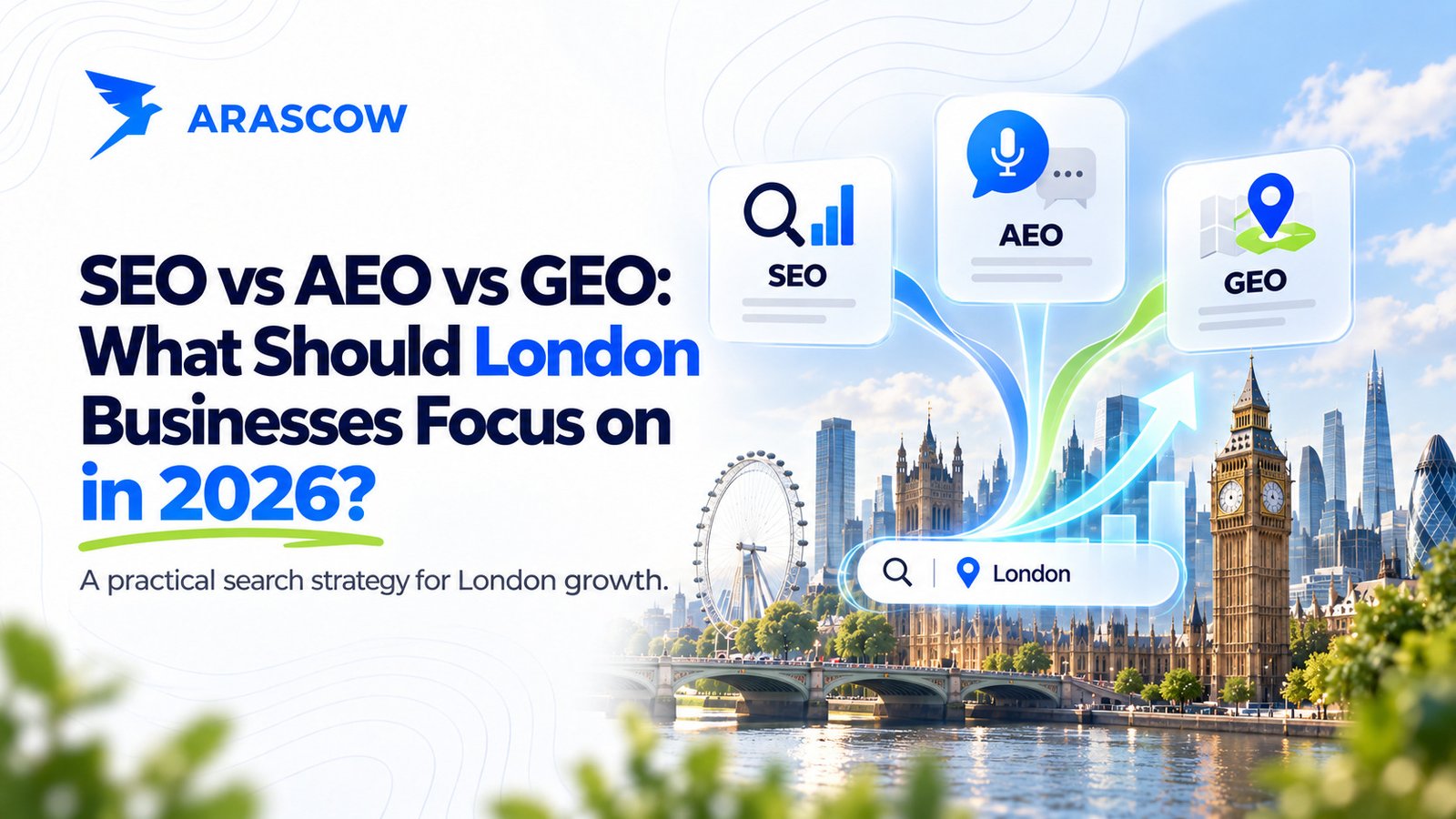
The way your customers search for your business online is going through a massive transformation. For over two decades, growing a business in London meant only ranking on the first page of standard search engines. Today, that old playbook is breaking down because people are no longer just looking at a simple list of website links. Instead, customers are turning to mobile apps, social media, and digital assistants to get direct answers to their daily questions. Relying entirely on old ranking positions is becoming highly risky because search platforms are changing how they show your business to the public.
This massive shift is happening because artificial intelligence and SEO AEO GEO is completely rewriting the rules of the internet. New platforms use generative technology to read the web, gather facts, and type out a complete paragraph directly on the user’s screen. If a customer gets a perfect answer without ever clicking a link, your website loses a visitor. To keep your online visibility alive in 2026, you must understand how these modern platforms find and select business information. You need to look past basic keywords, understanding the clear difference between SEO vs AEO vs GEO. This guide explains how to optimise your content so that both human shoppers and AI search optimisation choose your brand over your local competitors.
SEO: Still the Foundation of Online Visibility
What traditional SEO continues to do well
Standard search optimisation remains the absolute best way to organise your website so that the internet can read it properly. It builds a clean, fast, and structured home for your brand that tells search networks exactly what products or services you sell. By maintaining high technical standards, you ensure that your business remains visible when people look for concrete, direct services. This foundational setup is essential because newer digital platforms still rely on standard website data to learn if your business is legitimate.
The role of organic rankings in driving qualified traffic
Ranking high in traditional search results is still incredibly valuable because it captures customers who are actively ready to buy. When a user clicks a traditional link, they are explicitly looking to browse a website, compare prices, or make a final purchase decision. This direct traffic delivers highly motivated buyers straight to your landing pages without any middlemen. While AI search visibility is great for answering quick questions, standard web rankings are still the primary tool for turning online searches into actual cash revenue.
Local SEO for London businesses
Capitalising on neighbourhood searches is the most effective shortcut to beating national competitors who have massive corporate budgets. Local optimisation targets location-specific phrases, maps, and nearby customer reviews to put your shop in front of people in your exact area. When a customer in Soho or Camden looks for an immediate service near them, local algorithms prioritise geographical proximity over general domain authority. Perfecting this local approach ensures that your physical storefront or regional service business captures high-value neighbourhood traffic every single day.
Limitations of an SEO-only strategy in an AI-first environment
Relying entirely on old search methods creates a dangerous blind spot for your business as technology evolves. Traditional optimisation cannot help you if a customer asks a digital assistant to recommend a service instead of using a standard browser. When an AI platform builds an answer on the screen, it bypasses standard ranking lists completely and only highlights one or two sources. If your content is only optimised for standard links, your business will become completely invisible to the millions of users who now prefer instant, typed-out answers.
AEO: Winning Visibility in AI-Powered Answers
How answer engines select and display information
Modern response networks operate completely differently from classic search boxes because they do not match keywords to a list of links. Instead, these platforms scan the web to find direct, definitive statements that instantly solve a user’s problem. The software filters out fluff, matches the user’s conversational question against its database, and pulls the single most accurate answer it can find. This selected snippet is then read aloud by voice assistants or typed out directly on the user’s screen as the final solution.
Content formats that perform well in AI-generated responses
To get noticed by these digital response networks, you must format your text in a highly organised, question-and-answer layout. Using clear Frequently Asked Questions (FAQ) sections, direct bulleted lists, and simple definitions makes it incredibly easy for the software to read your page. AI SEO London looks for sentences that start with clear factual statements rather than long, artistic introductions. Structuring your data cleanly ensures that automated systems can easily lift your information and present it as the definitive answer.
The importance of authority, trust, and factual clarity
AI systems are involved in AEO for businesses and are deeply programmed to avoid spreading false information, so they strictly prioritise data from highly verified sources. Your business must back up every single claim with clear proof, verified customer reviews, and official credentials to build deep trust with the algorithm. The software evaluates your online reputation across multiple external business directories and forums before trusting your word. If your site features unclear facts or contradictory details, the system will completely ignore your business to protect its users.
Which business types benefit most from AEO
Service-focused companies, local trade businesses, and immediate service providers gain the highest value from this quick-response approach. When someone needs an emergency plumber in Kensington or a quick corporate catering quote in the City, they do not want to read articles; they want a fast answer. If your business provides clear pricing, fast booking steps, and direct service areas, these systems will constantly push your name forward. Focusing on this immediate delivery ensures you capture high-intent customers who want answers right now.
GEO: Optimising Content for Generative Search Platforms
How GEO differs from traditional SEO vs AEO
GEO for businesses focuses entirely on how large language models gather information to synthesise customised summaries. Traditional methods rank links, and answer systems pull single facts, but generative engine optimisation builds completely new paragraphs out of multiple mixed sources. This means your content is no longer competing for a spot in a list of web results. Instead, your text is fighting to be chosen as one of the trusted background sources that the artificial intelligence reads and cites while writing its own response for the user.
What makes content more likely to be referenced by AI models
Artificial intelligence models heavily favour unique perspectives, expert opinions, and real-world original data when constructing their responses. The algorithm easily filters out generic, recycled summaries and explicitly hunts for authoritative insights that add actual value to its summary. Including raw case studies, proprietary regional statistics, and detailed breakdowns makes your site a highly attractive reference point. The system will actively quote your text and place a small reference link next to your business name if your data helps it build a better answer.
Entity-based content, topical authority, and contextual relevance
Modern discovery systems do not just look at individual words; they map out your entire business identity as a connected digital object. To win their trust, you must demonstrate total expertise over your specific industry by covering a topic from every single angle. Creating a deep, interconnected network of helpful articles proves to the machine that your brand understands the full context of your trade. This comprehensive approach ensures the software recognises your business as a top-tier regional authority when matching user needs to local solutions.
GEO opportunities for competitive London markets
London features some of the most saturated commercial landscapes in the world, making standard search positions incredibly expensive to win. Generative platforms create a brand-new playing field where smaller, highly specialised brands can completely bypass dominant corporate giants. If your content speaks directly to highly specific local needs, such as boutique commercial law for tech firms in Shoreditch, the AI will recommend you for those niche requests. This contextual matching allows you to secure highly valuable client leads without needing a massive, multi-million-pound marketing budget.
Where London Businesses Should Invest Their Resources
Comparing the ROI potential of SEO, AEO, and GEO
Every marketing channel delivers a completely different return on your financial investment based on how customers interact with your brand. Traditional web optimisation requires a steady budget but delivers highly predictable sales because it captures buyers who are already looking to click and buy. Answer optimisation costs less upfront and provides massive value by putting your name in front of people who need quick, hands-free solutions on the move. Generative optimisation requires the highest amount of creative effort but offers incredible returns by positioning your brand as the premium, AI-recommended expert in your industry.
Which channels deliver short-term versus long-term value
Quick answer optimisation provides immediate short-term wins because it positions your business for instant, high-intent local queries today. Traditional search optimisation operates as a middle-ground strategy, taking a few months to build steady web traffic that can last for years if maintained properly. Generative model optimisation is the ultimate long-term play for the future of your company. Investing in deep, authoritative industry content protects your business against upcoming technology shifts, ensuring you remain the top choice as search boxes disappear.
Budget allocation based on business size and competition
Smaller neighbourhood storefronts with limited marketing budgets should focus their funds heavily on local search and quick answer optimisation to win nearby customers. Mid-sized companies operating in competitive boroughs need to split their spending between maintaining standard web rankings and building specialised generative content. Large corporate firms facing intense, city-wide competition must allocate significant resources toward building deep topical authority to dominate generative recommendations. Matching your budget to your actual business scale prevents you from wasting cash on strategies that are too complex for your current goals.
Common mistakes when adopting new search strategies
The most frequent error business owners make is completely abandoning standard web optimisation the moment a new digital trend appears. Moving all your money into Google AI search optimization without a strong, fast website foundation will cause your entire digital footprint to collapse. Another massive mistake is creating thin, generic text using basic software tools, which artificial intelligence models will completely ignore as spam. You must avoid chasing every single new application and instead focus on building genuine, high-quality information that holds real value for human readers.
Building a Future-Proof Search Strategy
Why integrated optimisation outperforms channel-specific efforts
Treating these new digital platforms as isolated marketing silos will only dilute your online performance and exhaust your budget. True digital visibility in 2026 comes from a unified approach where your traditional rankings directly fuel your AI answer engine optimisation. When your website code is cleanly optimised for search engine optimisation London, artificial intelligence models can pull data from your pages much faster. Combining these disciplines into a single, cohesive plan ensures that your business captures every customer, regardless of which app they use to find you.
Aligning website content with both users and AI systems
Your online copy must strike a perfect balance between providing a smooth experience for human readers and a clear data trail for machines. Human visitors demand engaging headlines, visually clear layouts, and simple navigation that helps them make fast buying decisions. At the same time, automated web crawlers require highly structured data tags and clear factual formatting to index your pages properly. Writing your text to satisfy both audiences simultaneously guarantees that you never sacrifice real consumer conversions while chasing algorithm updates.
Creating content that serves search engines and answer engines simultaneously
You can easily design a single webpage that ranks on the first page of Google while winning the top spot in a ChatGPT answer box. The secret lies in organising your page so it features an instant, data-rich answer right at the top, followed by a deep, detailed breakdown below. This layout allows an automated engine to quickly lift the summary paragraph for its instant voice responses. Meanwhile, traditional users can scroll down to read your full analysis, keeping your search traffic high and your engagement solid.
Developing authority across multiple discovery platforms
Modern discovery engines do not evaluate your business solely based on what you write on your own website. They scan the entire web to check what local newspapers, trade directories, and consumer review platforms say about your brand. To build a truly untouchable online reputation, you must grow your digital presence across multiple trusted external platforms. Securing regular mentions on local London business blogs, industry forums, and customer review networks forces every major algorithm to recognise your business as a trusted leader.
Final Analysis
London businesses cannot afford to treat online visibility as a choice between SEO vs AEO vs GEO platforms. Traditional search optimisation remains the essential foundation of your entire digital presence, as it builds the fast, clean website structure that all internet systems require. However, answer engine optimisation and generative search optimisation create massive additional opportunities to capture modern customers who demand instant solutions. By treating your website as an open, highly authoritative database for both humans and machines, you can stay ahead of the curve and dominate the local landscape throughout 2026. If you are looking for a reliable agency that can handle all of your SEO and digital marketing needs, you can contact the Arascow team right away.
FAQs
Is SEO still important with AI search?
Yes, because artificial intelligence models still rely on standard website data and clean technical code to find information and verify if your business is legitimate.
What is AEO and how does it help businesses?
Answer engine optimisation formats your text into clear question-and-answer layouts so digital assistants can easily find and read your information aloud to users on the move.
What is GEO in digital marketing?
Generative engine optimisation is the practice of designing highly authoritative, unique content that artificial intelligence programs select and cite as background sources when typing out summaries.
How can London businesses optimise for AI search?
You should structure your pages with direct bulleted facts, build deep articles around your industry topics, and collect verified customer reviews across local business directories.
Does GEO replace traditional SEO?
No, it builds directly on top of your existing search setup, using your established website authority to help you gain visibility inside newer generative search applications.