
Introduction
London businesses operate in one of the most competitive search advertising markets in the United Kingdom. Campaigns consistently pay 15–30% more per click than equivalent keywords in the rest of the UK. In high-competition sectors like legal services, a single keyword in central London can cost £12 per click, compared to £7 for the same term in Leeds. This cost premium makes the SEO vs PPC London decision more consequential for local businesses than for any other UK market. That’s why choosing the wrong channel or the wrong timing burns budget that could have compounded into a long-term digital asset.
UK businesses spent £16.9 billion on search advertising in digital marketing London in 2024 alone. A significant share of that spend underperformed, not because the channels don’t work, but because businesses entered them without a clear decision framework based on their specific situation. In this blog, we cover what local SEO London and Google ads London each deliver, what they each cost in the London market, and exactly which scenarios call for each channel or both. We have done in-depth research and sourced data from the current 2026 UK market. Our goal is to help you make informed decisions with straight information and clear data rather than a theoretical comparison that leaves the decision to you.
What SEO Actually Delivers and What It Costs?
Local SEO London is the process of earning organic rankings in Google’s search results. It involves technical website optimization, content creation, and building authoritative backlinks. In this process, you do not pay Google for each click because once a page ranks, traffic from that ranking costs nothing per visit.
Organic search drives 53.3% of all website traffic globally, making it the single largest source of measurable web traffic across every industry. SEO-generated leads close at a 14.6% rate, compared to just 1.7% for outbound channels such as direct mail or print advertising. The long-term ROI numbers reflect this closing rate directly.
The median B2B SEO ROI reaches 748% over three years, meaning £7.48 returned for every £1 invested. The financial case for SEO is built on compounding rankings already achieved, continuing to generate traffic without ongoing cost per click, while PPC requires continuous spend to maintain the same visibility.
In London, most businesses can see measurable SEO results within six months, but the timeline can exceed this in highly competitive industries. For businesses in sectors where organic competition is exceptionally dense, this timeline extends further. SEO pricing for UK small businesses typically runs between £200-£800 per month. It covers local SEO, Google Business Profile optimization, and content improvements.
What PPC Actually Delivers and What It Costs?
Digital marketing London is a temporary but instant placement method in which you pay Google directly for ranking your page at the top of search results. You set a daily budget and bid on your target keywords. You pay each time a user clicks your ad, regardless of whether it gets converted or not. When you stop the budget, your visibility ends immediately as there is no residual asset.
The primary advantage of PPC is speed. It produces results within 24 hours and reaches optimised performance within 30 days. For a London business that needs leads now or is launching a new service or a seasonal promotion, PPC is the best option to avail. In all the situations where organic rankings simply do not exist yet, PPC is the only search channel that delivers within that window.
The average Google Ads CPC across all UK industries in 2026 is £1.95 on Search. It comes with an average click-through rate of 4.7% and an average conversion rate of 4.4%. However, that average conceals wide industry variation that businesses must understand before budgeting.
On top of the ad spend paid directly to Google, agency management fees for PPC in the UK typically run between £300 and £2,000 per month, which is separate from your ad spend. The ROI from PPC averages approximately 155–200%, meaning roughly £2 returned for every £1 invested. It is profitable, but not in the same league as SEO over a 3-year horizon.
The Core Difference Between Two Channels
PPC is rented visibility
Every click costs money, so the month you stop paying on Google ads London, you disappear from page one. The cost per lead from PPC stays flat or increases over time as more advertisers enter your keyword auctions, pushing CPCs upward. The effective cost per lead from local PPC averages between £43–£85 after accounting for typical landing page conversion rates of 2–5%.
SEO is an owned asset
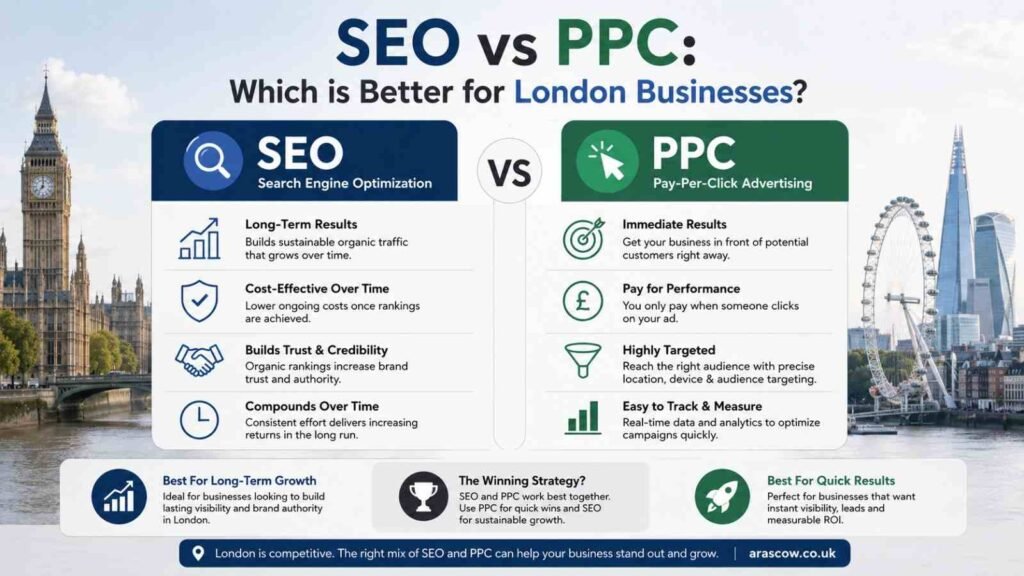
The rankings your website earns through SEO belong to your domain. Your website pages once reach first position on SERP for a high-intent keyword, remain there while continuously generating free traffic in the long run. Today, SEO delivers around 3.7 times higher ROI than PPC, and this gap continues to widen. As your domain authority grows, the cost per lead from SEO decreases.
Industry-Specific Considerations for London Businesses
Not all London sectors face the same search landscape. The right channel depends significantly on your industry’s keyword cost and competitive density.
Legal, Finance, and Property
These sectors face the highest CPCs in London, which can exceed £10.00 per click, compared to £4.00–£5.00 in less competitive UK regions. PPC remains viable here because a single converted client generates high revenue. However, the long-term case for SEO investment is equally strong.
Retail and E-commerce
Lower CPCs, usually under £1 in many cases, make PPC more accessible and less capital-intensive. However, e-commerce SEO, particularly product and category page optimisation, builds scalable organic traffic that does not depend on ongoing ad spend.
Local Service Businesses
Local SEO, specifically Google Business Profile optimisation, local citation building, and location-targeted content, delivers the highest conversion rates of any organic channel. Local services consistently convert highest from organic search because local intent queries carry strong purchase signals.
When PPC Is the Right Choice for a London Business
Ppc is good when you need instant but temporary results. It fulfils your momentary online presence needs effectively when you are new in the digital market. Choose PPC if you:
- Need leads fast: Ideal for short-term promotions as your new products get noticed fast in the market regardless of your position.
- Want to test new markets: Small PPC campaigns validate keyword conversions. It helps you build stronger SEO strategies.
- Own a new website: PPC helps you build domain authority and Google’s trust on your website while showcasing your services or products.
- Targeting high-value sectors: Legal/finance can justify £10+ CPC if client lifetime value supports acquisition cost.
When SEO Is the Right Choice for a London Business
SEO is a long-term game that helps you stay on the same Google page for years with little effort. Every time you don’t need to spend money to get new clients; rather, your online presence is already visible to everyone searching on the relevant keyword. You should choose SEO if you are interested in:
- Long-term investment: Works best with consistent monthly budgets. It multiplies ROI in around 18 months.
- Building digital assets: Organic rankings cannot be displaced overnight by competitor ad spend. You stay at your position for years with little maintenance.
- Multiplying returns: SEO builds lasting visibility and authority. It outperforms PPC in the long run, bringing organic traffic and qualified leads.
The Most Effective Approach: Use Both, Sequenced Correctly
For new businesses or product launches, an around 70% PPC weighting makes sense. In that period, usually organic rankings are being built. You can later shift that budget in the same ratio towards SEO over 6–12 months as organic traffic grows.
If you have already established businesses with existing domain authority, the optimal split is approximately 70% SEO and 30–40% PPC. Using paid search, you can capture high-intent keywords where organic rankings are not yet competitive.
The two channels also improve each other directly as PPC campaign data reveals which keywords convert at the highest rate. That data also informs which organic content pages to prioritise. Strong SEO improves Google’s Quality Score for your PPC ads. It directly impacts your cost per click, reducing it substantially.
Commercial intent searches remain largely unaffected by Google’s AI Overview summaries. In these searches, the users are actively looking to buy, compare, or hire. It means both channels continue to deliver measurable results on high-intent queries in 2026.
Final Analysis
There is no universally correct answer between SEO vs PPC London, because the right one is one that fulfils your business needs. It depends on your expected duration for the results, target keyword cost per click, and investment plan. For fast lead acquisition, PPC is the ideal choice, while for long-term growth, SEO is the best option. In most cases, the most capital-efficient approach is running both simultaneously. It involves using PPC for immediate lead generation while SEO compounds in the background. At Arascow, we manage both SEO and PPC campaigns for London businesses across competitive industries. If you want a clear assessment of which channel or which combination is the right investment for your specific market, contact our team for a straightforward audit of your current search visibility and a channel recommendation based on your revenue goals.